
Disadvantages of Mirrorless Cameras: Do They Matter To You?
Disclosure: This post may contain affiliate links. I earn a small commission of product sales to keep this website going.
I've been loving the contributions that mirrorless cameras have made to my photography evolution and my capabilities as a minimalist backpacker & traveler. They have many advantages to a lightweight traveler, but there are also a few important disadvantages of mirrorless cameras.
Will these disadvantages put you off from a mirrorless camera? Keep reading for a breakdown of what I think are the most important things to consider when going mirrorless. These are mostly aimed at the traveler and outdoor enthusiast.
Related:
Sensor exposure
When you change the lens on a DSLR, the sensor is mostly protected by that mirror that sits right in front of it. Dust can still get into the camera housing when you change lenses, but floaties in the air are less likely to land on the sensor.
When you change the lens on a mirrorless camera, bam, the precious, delicate sensor is vulnerable to the world, right there in front. This is one of the most expensive disadvantages of mirrorless cameras.
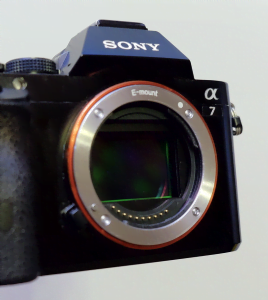
I've made a quick lens change only to find a black stripe in the middle of my electronic viewfinder. It was a tiny little piece of threading or something that had found its way to the middle of the sensor in those few seconds it was exposed to the air. A quick blast with a rocket blower cleared it out, but it was still a bit of a scare. Even worse can happen if you're not careful.
A backpacking & travel photographer can mitigate this disadvantage by turning their back to the wind during a lens change and remember the following:
- Make sure the lenses are ready to swipe out before removing the lens from the camera.
- Have the air blower ready to blow out any dust right before the change.
- Activate the sensor cleaning function on your camera, where a quick vibration will knock most loose dust off of the sensor.
Electronic viewfinder limitations
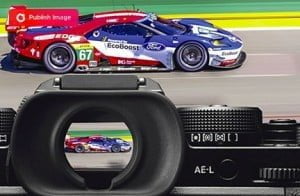
Electronic viewfinder capabilities have come a long way in the past few years and will only continue to improve over the next few. Still, this is one of the disadvantages of mirrorless cameras that keeps DSLR enthusiasts from jumping aboard the mirrorless train.
When you look through the viewfinder of a DSLR, the prism and mirror show you exactly the light that's reaching the front of the lens at that exact moment in time. There are no tricks. You're just looking through the lens.
The electronic viewfinder (EVF) of a mirrorless camera shows you what's happening after the light goes through the sensor and processor. This has some wonderful advantages, but also some disadvantages:
- Slight loss of clarity due to limitations of pixel density. Between the Fujifilm X-T2 and X-H1, the EVF resolution increased from 2.36 million dots to 3.69 million. Sony's new OLED EVF, not yet in any camera, boasts 5.6 million dots.
- Processor lag means that what you're seeing in the EVF isn't what's happening at this exact same instant. However, the display time lag of the X-T2 and X-H1, for example, is only .005 seconds, so I'd challenge you to notice that difference.
- Along with processor lag, you're also dealing with display refresh rates. This too is continuing to improve, with an increase from 60fps to 100fps between the X-T2 and X-H1. Sony's new EVF has a refresh rate of 240fps - nearly fluid.
- EVFs are limited in low light just as the sensor is. You'll notice grain, lose clarity, and have lower refresh rates. Today's low-light sensors are reducing this limitation.
Battery life
Battery life is yet another one of the disadvantages of mirrorless cameras that's slowly closing in on DSLRs.
All of that EVF processing happening in the section above really uses up the juice. You'll have to carry extra batteries or charging solutions on extended outings.
The original Sony a7 had a CIPA standard battery life of 270 shots with the EVF and 340 with the LCD. The Canon 5D Mark II DSLR's battery could get you through 850 shots using the optical viewfinder. The Sony a9 currently has one of the best mirrorless battery capacities of 480 shots with the EVF and 650 with the LCD. Expect this to continue to improve.
You can extend the battery life of mirrorless cameras using the tricks I outline in Extending Mirrorless Camera Battery Life On The Trail.
Ergonomics
We love mirrorless cameras because they're small.
The small size, however, doesn't fit well in large hands. Holding the small grip for extended periods might cause your hands to cramp up. This is a disadvantage of mirrorless cameras that we'll always be dealing with.
I've never had a problem with cramping, however, and I quickly became accustomed to the tighter arrangement of controls.
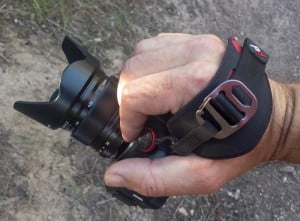
Extended hand grips are available for most mirrorless cameras. I also use the Peak Design Hand Clutch to give my hand a grip break when I'm not actively shooting - this reduces a lot of hand fatigue.
Lens selection
Mirrorless camera lens mounts are extremely new compared to the Canon EF/EF-S and Nikon FX/DX lens mounts that have been out for decades.
Sony originally had about 10 lenses when the a7 and a6000 were released, but they now offer in the neighborhood of 40 lenses.
Third-party manufacturers are also producing mirrorless lenses just like they do for DSLRs.
It shouldn't be long before photographers have all of the lenses they need for mirrorless cameras.
Most travel photographers already have what they need with a selection of fast zoom lenses.
Will these disadvantages of mirrorless cameras be a deal-breaker for you?
Further reading: Advantages of mirrorless cameras vs. DSLRs, Mirrorless Camera Photography Tips


As a user of both mirrorless and DSLR, I can attest to an additional advantage of going "old school" If you are observing nesting birds or other wildlife from a distance, you can turn off the DSLR, put in in manual focus and aim it at the nest or other spot, in effect, using it as a telescope. In this way, you don't drain the battery or risk overheating electrical components. When you are ready, just turn it on and take the shot.
I would gladly exchange that ability (which I never have a need for) for a lighter kit and a happier back!
DSLR camera bodies are comparatively larger, as they need to fit in both a mirror and a prism. The body of the Nikon D3500, for example, is smaller than its predecessor, but still a rather bulky 3 inches deep before you put the lens on the front. With the 18-55mm kit lens, the camera weighs about 1.5 pounds.
A mirrorless camera body can be smaller than a DSLR, with simpler construction. The Sony A6300 has a body just 1.6 inches thick and weighs 1.75 pounds with its 16-50mm kit lens.
https://www.tomsguide.com/us/dslr-vs-mirrorless-cameras,news-17736.html
So the mirorless weighs more?
The information in that article isn’t accurate; the weights are a wash when you look at the manufacturer specs. Also remember you’re comparing a $400ish entry-level DSLR to a $1100ish professional mirrorless.
The exposed sensor alone is what turned me off of the mirrorless. I shot with a Sony A7Sii and had a whole days worth of video ruined because of a bit of dust on the sensor...irreplaceable interviews and b-roll shots had to be tossed. I'll never go back.
Oh I'm sorry to hear that - that experience would definitely ruin it for me too. It's a great camera otherwise. A lot of care has to be taken when changing lenses, with proactive measures to prevent dust. I usually stick with one versatile zoom lens in environments where I don't want to chance it.
The most serious drawback to mirrorless that I see is the sensor exposure. I've long been curious why the camera makers couldn't configure a "lens-change" mode that would close the shutter and keep it closed until a lens is safely remounted.
Yeah that’s a huge one. There oughta be a way to keep it covered. There are a few reasons why it’s impractical/difficult/dangerous to use the actual shutter. Hopefully the engineers soon come up with a way to do it without adding any extra bulk or weight to the cameras.
Out of interest, how do you find the mirrorless battery life compares in the real world vs the standard cipa figures? Curious as my D7200 is rated at 1110 shots cipa, but my typical use can get well over 2000 shots from a full charge.
Well if it’s going to be wrong, that’s a good direction for it to be wrong! I’ve never really paid much attention - I’m more focused on the task at hand than counting frames and I usually swap out a fresh battery when it’s convenient rather than running it dead. Maybe I’ll try this week or next as I’m in Alaska, but cold weather will also affect that.
The thing that I haven't heard a lot of mention of is how much control you get on the display on a mirrorless camera.
Is it possible to take pictures with the display off? Can you keep the display from coming on when you take a shot?
I shoot almost exclusively looking through the lens, and there are several electronic viewfinder limitations I don't see mentioned here which basically boil down to a couple of things:
1. Battery life - this is mentioned as a separate disadvantage, but it doesn't specifically call out the power required to run the screen, just the processing power to push the pixels. As mentioned in another comment, one can look through a telephoto lens all day waiting for a shot without needing any battery. In fact, sometimes I look through my telephoto just to get a closer look at something and without any intention of even taking a shot. When taking hundreds or thousands of pictures (for instance, for a large panorama stitch) not having the drain of a screen is also advantageous as having to stop to change batteries can subtly shift the camera location and mess up the remainder of the shots.
2. Light emissions - have you ever been in a dark hall shooting with a telephoto shooting a performance a bright stage? Am I the only one who finds all the people holding up their camera phones distracting with all the light they emit? Sometimes I want to shoot and not be emitting any light, either because I'm in a dark place with other people and I don't want them to see what I am doing. With a mirrorless camera this would seem to be impossible unless you have a tripod and have preframe the shot. If I am shooting a long exposure at night I don't want any stray light to get back into the sensor.
Also, if I am shooting a time exposure during the day, I don't really need the screen to be on the whole time because it's a bit more wear on the screen for it to be on for hours (making things warmer, including the battery) when it's only taking a few frames per minute. I would assume... hope... that mirrorless cameras can be a bit smart about this - my camera shows a review image for a couple seconds after each shot for review and then turns off the display until the next shot.
Hi Michael, those are great points, and thankfully the engineers have addressed them.
I almost exclusively shoot through the viewfinder. I can turn the LCD screen off and disable the image review feature. So my LCD screen never comes on at all no matter what I'm doing.
Further, I can also keep the electronic viewfinder off until a photosensor next to it detects my face, at which point it will turn on for me so I can see what I'm doing. Then when I put the camera down it turns back off. Or you can just keep everything off all the time.
I had this setup with both Sony and Fujifilm and I'm sure the others have similar features.
These will all help increase your battery life and avoid light pollution.
I'd like to add, that an EVF sits so close to your eyes, that your eye needs to focus much more closely than when looking through a mirror into the wild. I feel, that my eye's lens (pupil) does not need to contract that much when using a mirror view finder as almost all objects are more far away. Because of that mirrors used in cars for the drivers extended view (side and rear mirrors) will not be replaced by displays competely as it takes a lot of time to focus closely and then, when looking back at the street or at your model in front of the camera your eyes need to focus again several meters away. I vote for a mirror viewfinder with detailed overlay to show parts in focus or parts that are to bright.
Shutter shock in manual mode at low speed, rolling shutter, banding... so many other problems with mirrorless!
Those aren't problems with mirrorless cameras specifically. DSLRs have these problems too. In both cases they're only "problems" because the photographer chooses the wrong setting/setup for the situation.
When you wrote this article on 2019, I think some of your opinion has been left behind. I think, since 2018 they are growth and bombardier some new models with very good improvement.
They have made some good improvements, but overall I think still fall behind in some of these categories. With that said, I've been a mirrorless user for six years now and absolutely love them!
I've tried shooting with the mirrorless. But just like Kobe Bryant says he loves the squeaking of the sneakers on the court, I love the weight and the sound of the shutter. I shoot sports and models. I can "feel the shot" more with a DSLR ( I shoot with the 1DX) more so than a mirrorless. I just wish camera manufacturers would keep their line of DSLRS for those that like shooting with them. Can both cameras coexist together in the market?
Yeah I definitely think they can coexist, but unfortunately the camera manufacturers have other motivations for producing the cameras that they do.