
Disclosure: This post may contain affiliate links. I earn a small commission of product sales to keep this website going.
Now that the X-T30 III has arrived, the X-T30 and X-T30 II are no longer Fujifilm’s latest and greatest. But they’re still very capable cameras, and they’re going to be around for a long time on the used and discounted market.
So the real question becomes:
If you’re choosing between an X-T30 and an X-T30 II today, are they really that different, and is the mark II worth paying more for?
On paper, the bodies look almost identical. Many “review” sites wrote them off as the same camera with a nicer screen. But under the hood, there are enough changes that it’s worth looking at how they perform in real-world use, not just on a spec sheet.
This is not a full review of the X-T30 II. It’s a practical comparison for people deciding which one still makes sense in 2025, especially now that the X-T30III exists for those who want the newest tech.
And you can also find an X-T30 II setup guide here.
Who the X-T30 and X-T30 II Are For
Short version: either of these cameras can work for almost anyone who wants a small, capable, fun Fujifilm body.
As a primary camera
Both the X-T30 and X-T30 II are great for:
- Enthusiast photographers who want a compact travel and everyday camera
- Professionals who want a lighter body that still produces solid files
- Photographers coming from other systems who want to “try Fuji” without jumping straight into the flagship bodies
Calling the X-T30 “entry-level” does it a disservice. It just happens to sit at an attractive price point.
The X-T30 has been a strong seller since its release, and the X-T30 II was essentially Fujifilm’s way of giving that popular platform some newer internals without redesigning the entire camera.
As a secondary / backup body
This is where the X-T30 II really starts to make more sense, especially paired with newer bodies.
For years, I used an X-E3 alongside my main cameras. It was small, easy to keep in an underwater housing or dedicated to a specific lens, and it did the job. But it started to fall behind in performance and in the newer image-quality tools that I rely on now.
The X-T30 II, with internals that largely match the X-T4 generation, lines up much better as a second body for:
- X-T4, X-Pro3, or similar fourth-gen Fujifilm cameras
- Situations where you want the same film simulations, color tools, and AF behavior across both cameras
If your primary camera is from that generation, the X-T30 II is simply easier to keep in sync than the original X-T30.
Exterior Differences: Basically the Same Camera
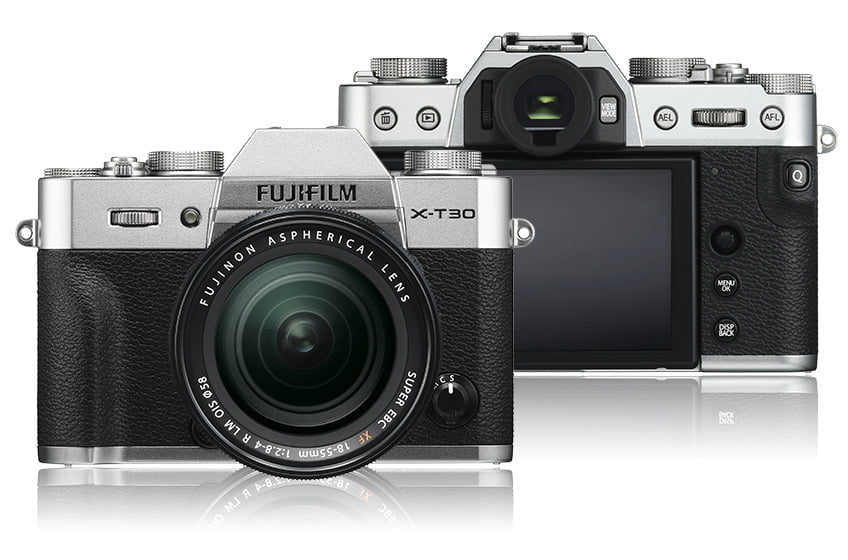
Physically, the X-T30 and X-T30 II are almost indistinguishable.
- Same body design
- Same control layout
- Same lack of weather sealing
- Same overall feel in the hand
The front nameplate doesn’t even say “II.”
The only meaningful physical difference is the rear LCD:
- X-T30: 1.04M-dot LCD
- X-T30 II: 1.62M-dot LCD
You’ll only really notice this if you put the cameras side by side. It’s a nice improvement, but not something most people will upgrade for by itself.
Weight and dimensions are essentially the same; on paper, the X-T30 II is a bit lighter, but you won’t feel it in use.
Performance Differences: Where the X-T30 II Pulls Ahead
Inside, things get more interesting. The sensor and processor are the same across both cameras (same generation as the X-T3/X-T4), but the X-T30 II has updated boards and more memory. That allows Fujifilm to give it many of the features and performance gains you see in the X-T4.
Autofocus
The X-T30’s autofocus is fine for most general shooting, especially with the firmware updates it received, but it isn’t ideal for fast action or low light.
The X-T30 II improves on this in a few key ways:
- Rated low-light AF down to roughly -7EV under ideal conditions, versus -3EV on the X-T30
- Updated Face & Eye Detection algorithms for more reliable subjects and fewer “ghost” detections
That four-stop difference on paper is significant. In practice, it means the X-T30 II simply locks focus more confidently in dim conditions and with moving subjects.
If your photography involves:
- Indoor events
- Night street shooting
- Kids, pets, or anything moving quickly
…the X-T30 II’s AF improvements are worth paying attention to.
Image Quality Settings: Where JPEG Shooters Win Big
One of the biggest differences between the two cameras is in the Image Quality (IQ) options. The X-T30 II gets most of the newer generation’s tools for dialing in your JPEGs in-camera.
The X-T30 II adds:
- Film simulations: CLASSIC NEG, ETERNA BLEACH BYPASS, plus updates to AUTO mode behavior
- CLARITY control
- Improved COLOR CHROME EFFECT
- COLOR CHROME FX BLUE
- Additional Auto White Balance modes: White Priority and Ambience Priority
- A unified Tone Curve control instead of separate highlight/shadow sliders
- HDR drive mode
- Expanded monochrome tint controls via MONOCHROMATIC COLOR
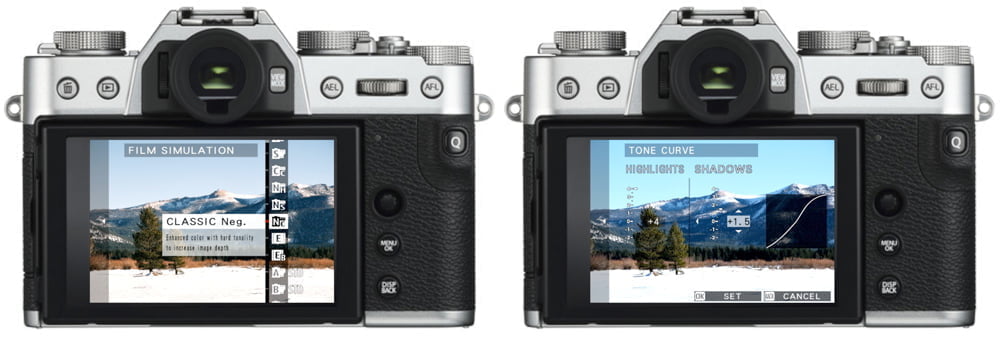
Some of these features, especially CLARITY, need more memory and processing than the X-T30 has available. That’s why you couldn’t just get them via firmware.
If you like to get your photos as close to final in-camera as possible using film simulations and JPEG workflows, the X-T30 II is a much more flexible tool. It essentially brings the X-T4-era image-styling tools into the smaller X-T30 body.
The Scene Recognition algorithms (for users who keep the lever in full AUTO) are also updated to better detect and handle different scenarios.
Video Differences
Neither camera is aimed at professional filmmakers, but the X-T30 II does smooth out a few video limitations.
Both cameras:
- Shoot 4K up to 30p
The X-T30 II improves:
- Full HD High Speed Rec up to 200/240fps (on top of 100/120fps)
- 4K recording limit up to 30 minutes (from 20 minutes on the X-T30)
- A cleaner, more organized movie menu structure similar to the X-T4, splitting settings into image quality, focus, audio, etc.
If you mostly shoot stills but want decent control over basic video, the X-T30 II is simply nicer to live with.
Menu System and Custom Settings
This is one of the under-the-radar changes that affects day-to-day handling more than people expect.
On the X-T30 II, Fujifilm moves to the newer Custom Setting system. Instead of Custom Settings being mostly about image style (your “film recipes”), they now also save:
- Focus behavior (area, Face/Eye detection, etc.)
- Shooting options (Sports Finder, shutter type)
- Flash and other operational settings
This makes the X-T30 II behave more like many other digital cameras: custom banks are true “shooting setups,” not just looks.
Some Fuji shooters really like this. Others dislike having operational settings “locked” to a recipe when they want to change one without affecting the other. How you feel about this will depend on how you like to work.
The X-T30 II also adds smaller but useful tweaks:
- AF Range Limiter
- Interval Timer Exposure Smoothing
- View Mode setting in the menu, with the physical View Mode button now customizable
- Q Menu background options (transparent or black)
- Separate programming for focus lever push vs tilt
- Customizable BOOST performance behavior
Individually, these are small, but together they make the X-T30 II feel more refined and flexible in daily use.
So… Should You Still Get an X-T30 or X-T30 II in 2025?
First, keep the bigger picture in mind: your camera should match the minimum kit you need to do the work you actually do, not a spec race.
Now that the X-T30 III exists, you’re likely looking at:
- Used or discounted X-T30
- Used or discounted X-T30 II
Here’s a simple way to think about it.
Go for the X-T30 if:
- Your budget is tight, and you can get it significantly cheaper than an X-T30 II
- You don’t need the newer film simulations or JPEG tools
- You mostly shoot in good light and don’t rely heavily on continuous AF or low-light AF
- You just want a solid, small Fuji body for travel, family, and everyday work
Go for the X-T30 II if:
- You want AF that holds up better for action and low light
- You care about the newer Image Quality tools (Classic Neg, Color Chrome FX Blue, Clarity, etc.)
- You like shooting JPEGs and want more control in-camera
- You do occasional video and will use the longer 4K limit and better movie menus
- You want a backup body that feels more in line with cameras like the X-T4 and X-Pro3
You can check out the current kits available for the X-T30 II at B&H Photo.
If you are already an X-T30 owner, upgrading to the X-T30 II only makes sense if you will genuinely use:
- The AF improvements
- The updated Image Quality tools and film simulations
- The extra video features
If the original X-T30 still does the job, there’s no reason to force an upgrade just because a mark II exists.
Where the X-T30 II Fits Now That the X-T30 III Is Out
With the X-T30 III now on the scene, the X-T30 II becomes the “sweet spot” for many budget-minded shooters:
- Cheaper than the X-T30 III
- More capable and future-proof than the original X-T30
- A strong second body for current-gen Fuji shooters
If you want the newest features, you’ll want to look at the X-T30 III comparison (I’ll have a separate article on that). But if you’re realistic about what you need and watching your budget, a used X-T30 II can be a very smart buy.
And whatever you end up with, there’s a full line of Fujifilm camera tutorials available to walk you through setup, menus, autofocus, and real-world use so you can get the most out of the camera you already have.
Abraham
Tuesday 7th of February 2023
I am a little disappointed because I specifically switched from Canon to fuji when I got the xt30, partly because of their reputation of supporting their cameras with generous firmware updates. If they could give these features to the xt30 but don't, that's sounding a lot more like Canon's tendency to cripple their products.
Jörg
Saturday 5th of February 2022
Hi John, coming from a X-T10 I'm thinking about upgrading to a X-T30 ii or X-E4. I have to admit that I like the design of the X-E4 much more than that of the X-T30 ii but I don´t like that they have removed so many buttons. It also worries me a bit what you have explained about how the Custom Settings now work, although this is obviously a problem of both bodies, so no difference here (I also watched your video about the X-E4 "Making Sense of this New Mess"). Would you say that having to live with this new way of how Custom Settings work anyway (because both cameras have it) it would be preferable to get the X-T30 ii because you can somehow compensate for this "new mess" with having at least more buttons? I understand that the buttons would always override whatever has been programmed in the Custom Settings, so the more buttons you have the more you can still use the camera in a different way than what has been programmed in the Custom Setting without going back all the time to the menu.
Actually, I was convinced already to go for the X-E4 because this time I wanted to have a rangefinder-style body (and cannot afford the XPro3) but now I'm having serious doubts again... I was not aware of this issues with the Custom Settings...
Thank you!
Jörg
Monday 7th of February 2022
@John Peltier, Thank you, John! Much appreciated. Why did you finally get the X-T30 ii and not the the X-E4? Was it just for the function buttons and controls? I mean, under the hood they‘re both the same...
John Peltier
Monday 7th of February 2022
I think this is the way the winds are blowing. The last three X-series cameras had a custom setting structure like this (the X-S10 also). So it may be time to bite the bullet. I'm currently using my X-T30II alongside my X-T4 in Peru, and while I'm still getting tripped up by certain settings that I'm not used to changing when I change custom settings, it is nice having extra controls on the camera (like a Focus Mode that won't change with the custom settings) and more. If you're coming from the X-T10 you just might prefer the X-T30II, aside from wanting a rangefinder design.
Steven Roberts
Friday 28th of January 2022
Hi. I think Fuji are great at providing software updates whenever they can which keeps your kit up to date. The upgraded X-T30, as you say, is an upgrade not available via software. As an X-T20 user, I have ordered the upgrade - it will save me as an amateur, paying out for an X-T4 which I was thinking about but still give a similar level of quality images. Probably wouldn’t upgrade it I had the first X-T30. Best wishes and thanks for the blog..
John Peltier
Friday 28th of January 2022
I think you'll love it! An X-T4 in an X-T20-sized (& priced) body, although without IBIS, but we can all manage just fine without that :) I just got my X-T30 II last week and have been putting it through the paces before taking it to Peru next week as my secondary body. I have full confidence in it.
Conner
Thursday 13th of January 2022
I currently have the X-E4 but planning to switch to the X-T30II. How do the custom settings like focus interact with the MCS switch? Does the switch override the custom setting?
John Peltier
Friday 14th of January 2022
Nothing with a physical switch can be saved to the Custom Settings, so the Focus Mode (M/C/S) can't be saved, it'll just be whatever the switch is set to.
Marko
Thursday 13th of January 2022
"You can now record 4K video at 59.94fps instead of being limited to FHD at that framerate."
Is this really true? The official specs sheet on the Fujifilm's website states that 4K and DCI resolutions go only up to 29.97p.
I'm looking to get the X-T30II as a backup camera for my video projects, but more often than not I need to shoot at DCI 4K 60p so it would be perfect if this little guy can do it.
John Peltier
Thursday 13th of January 2022
No you're right, the press release states 4K/30, I must have misread the specs elsewhere and wanted to believe it was true since the X-T4 can do it :) Thanks for the correction.